
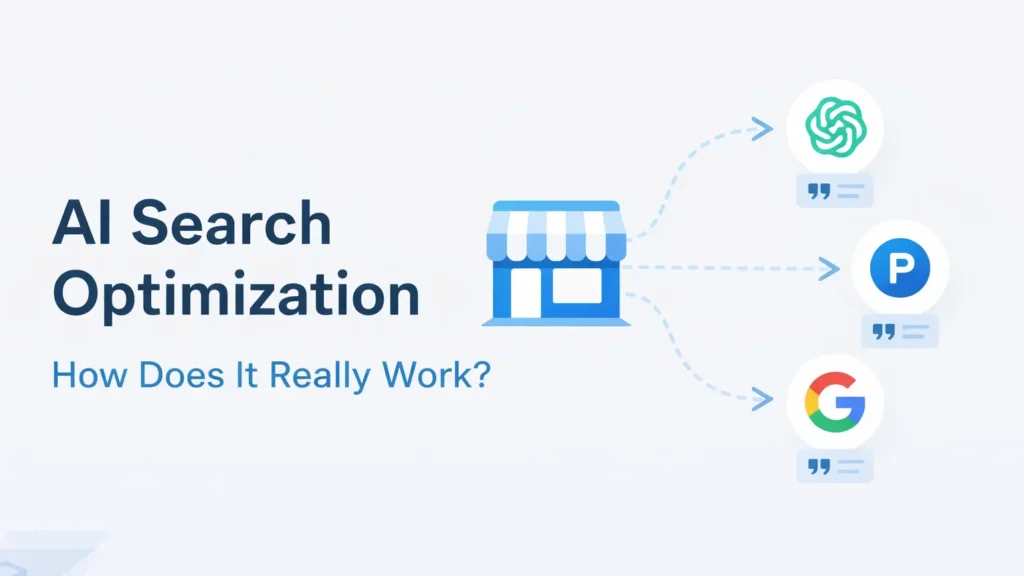
Search is changing faster than most businesses realize. The way people find products, services, and answers online is shifting from typing keywords into Google and scrolling through blue links to asking AI tools a question and getting a direct answer. If your business is not part of that answer, you are invisible to a growing segment of your audience.
If you are already stretched thin trying to keep up with regular SEO, the last thing you want to hear is that there is a whole new system to learn. That concern is valid. But here is the honest truth: AI search optimization is not starting over. It builds directly on what you already know and what good SEO practice already demands. I have worked with small and local businesses on SEO long enough to know that the ones who adapt early consistently outperform the ones who wait for certainty.
This guide breaks down exactly what AI search optimization is, how it works, which platforms matter, and where a small or local business should actually start. No fluff, no enterprise-level assumptions.
What Is AI Search Optimization?
AI search optimization is the practice of structuring your content, building your authority, and strengthening your online presence so that AI-powered search tools recommend, cite, or feature your business in their responses.
Traditional SEO gets your website ranking in Google. AI search optimization gets your business mentioned, cited, or recommended when someone asks ChatGPT, Perplexity, Google AI Overviews, or similar tools a question relevant to what you do.
The terminology around this space is genuinely confusing, so here is a quick breakdown:
- Answer Engine Optimization (AEO) is the practice of optimizing content to appear in direct answer formats across voice search, featured snippets, and AI-generated responses.
- Generative Engine Optimization (GEO) is specifically about optimizing for generative AI platforms like ChatGPT and Perplexity that synthesize answers from multiple sources. Where AEO is broader, GEO is platform-specific.
- LLM SEO refers to optimizing your content so large language models understand, trust, and reference it when generating responses.
AEO is the broader framework. GEO and LLM SEO are more specific applications within it. Understanding the difference matters because each one shapes how you approach your content and which platforms you prioritize, which is exactly what we cover next.
What Does AI Search Look Like in Practice?
Picture this. A potential customer in your city opens Perplexity and types: “What is the best HVAC company near me for a boiler replacement?” Perplexity does not return a list of ten blue links. It synthesizes an answer, recommends two or three businesses or resources, and cites its sources with direct links.
If your business has strong local citations, authoritative content about boiler replacements, positive reviews across multiple platforms, and a well-optimized Google Business Profile, there is a real chance your name appears in that answer. If you have none of those things, you will not.
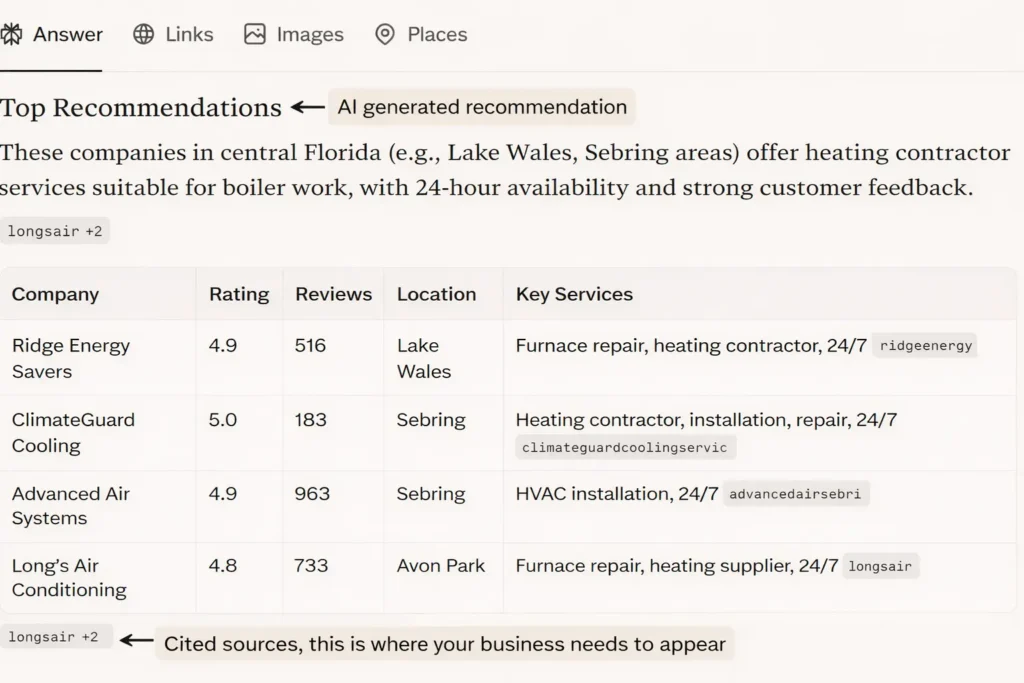
That is the fundamental shift in how businesses appear in AI answers. AI search tools are not just indexing pages. They are making recommendations. And to get recommended, you need to be trustworthy, authoritative, and clearly relevant to the question being asked. That is exactly what AI generated search results reward, and it is what the rest of this guide will show you how to build.
Why AI Search Optimization Matters for Your Business
The scale of AI search adoption is no longer a future projection. According to OpenAI, ChatGPT now has over 400 million monthly active users and processes roughly one billion queries per day. According to Perplexity’s CEO, the platform processed over 780 million queries in May 2025 alone, with month over month growth showing no signs of slowing. And within Google itself, according to a Sparktoro and Datos study tracking real Google searches, AI Overviews now appear on approximately 48% of all tracked queries, up 58% year over year from February 2025 to February 2026.
That last number matters most for small businesses. A Pew Research study tracking 68,879 actual Google searches found that when AI Overviews are present, click through rates on traditional results drop to just 8%, compared to 15% when no AI summary appears. Users who get a complete answer from an AI overview have less reason to click through to your website. Ranking in Google is no longer enough on its own. If you are not showing up in AI answers, you are losing visibility at the top of the funnel before users ever reach your site.
Before we go further, let us address the misconceptions that trip most business owners up.
- Myth 1: AI search optimization is just SEO with a new name. It is not. Traditional SEO focuses on ranking pages for keywords. AI search optimization focuses on being cited as a trusted source in synthesized answers. The signals, the content formats, and the platforms involved are meaningfully different, even if there is significant overlap between the two.
- Myth 2: You need to scrap your existing content strategy and start over. You do not. If you have been creating quality content, building genuine authority, and focusing on E-E-A-T, you are already ahead. AI search optimization layers on top of a solid SEO foundation. It does not replace it.
- Myth 3: This only matters for large brands. This is the most damaging myth for small business owners. Local and niche businesses have a genuine advantage here. A deeply knowledgeable local plumber who consistently produces helpful, specific content about local plumbing problems can outperform a national brand on local AI search queries. Specificity and genuine expertise win.
The early mover advantage is real. The businesses building topical authority and citation signals now will be significantly harder to displace once the AI search landscape matures and competition increases.
How Is AI Search Different From Traditional Google Search?
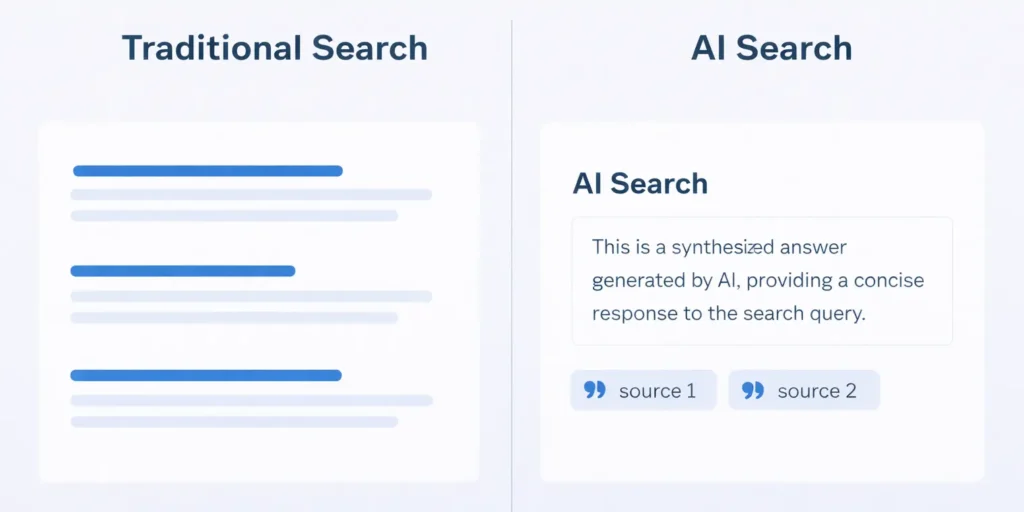
Understanding how AI search differs from traditional search is the fastest way to see why a separate optimization approach is needed, and why the two work better together than apart.
| Factor | Traditional Google Search | AI Search |
| How it works | Crawls and indexes pages, ranks by relevance and authority | Trains on large datasets, retrieves and synthesizes information |
| User query format | Keywords and short phrases | Conversational questions and natural language |
| Result format | Ranked list of blue links | Synthesized answer with cited sources |
| What gets rewarded | On-page optimization, backlinks, technical SEO | Authority, trustworthiness, E-E-A-T signals, direct answer formats, citations |
| Click behavior | User clicks through to website | User often gets answer without clicking |
| Search intent handling | Matches pages to keywords | Interprets intent and generates a contextual response |
The most important thing to understand here is that AI search does not replace traditional search. Google still processes billions of queries every day and organic rankings still matter enormously. What is changing is that a growing layer of search behavior now bypasses the traditional results entirely. Optimizing for both is the smart play. The good news is that the foundations are more shared than they are different, which means the work you are already doing in SEO is not wasted. The difference between SEO and AI search optimization is largely one of emphasis and format, not a complete rebuild.
Does AI Search Optimization Replace SEO?
No. And anyone telling you it does is either confused or selling something.
Traditional SEO and AI search optimization are complementary. SEO builds the foundation: quality content, technical health, backlinks, and authority signals. AI search optimization builds on top of that foundation by optimizing the format, structure, and authority of your content specifically for how AI tools evaluate and cite sources.
What carries over directly from SEO:
- Content quality and depth that directly answers the questions your audience is actually searching for, not just content that targets keywords and hopes for the best
- E-E-A-T signals including visible author credentials, a detailed about page, and claims supported by credible external sources, all of which AI tools use to assess whether your content is worth citing
- Topical authority built through a cluster of interlinked content that covers a subject comprehensively, signaling to AI tools that your site is a reliable source on that topic
- Structured data that makes your content machine-readable, helping AI tools correctly identify what your page is about, who wrote it, and what specific questions it answers
- Backlink authority from credible and relevant sources, which AI tools treat as a third-party trust signal, much like Google does but with heavier weight on source relevance and reputation
What is new with AI search optimization:
- Optimizing for conversational queries by writing content that mirrors how people actually phrase questions to AI tools, full sentences and natural language rather than fragmented keyword phrases
- Structuring content to lead with the direct answer first, then support it with context and detail, because AI tools pull the clearest and most immediate response available
- Building consistent brand mentions across review platforms, local directories, industry publications, and third-party websites so AI tools encounter your business name repeatedly across trusted sources and treat it as established and credible
Think of it this way. If SEO is getting your business on the map, AI search optimization is making sure the AI giving directions actually recommends your street.
How Do AI Search Engines Actually Work?
Most AI search tools use a process called Retrieval Augmented Generation, or RAG. Here is what that means without the jargon.
When you ask an AI search tool a question, the system does two things simultaneously. First it draws on the knowledge baked into its language model from training data. Then it retrieves current, relevant information from the web to supplement that knowledge. It combines both sources and generates a synthesized response. The AI does not just rely on what it already knows. It actively goes looking for the best available answer, then presents it with cited sources so the reader can verify where the information came from.
The retrieval part is where your content either gets selected or gets skipped. The signals AI search uses to rank content and decide what gets cited come down to four core factors:
- Source authority: How well established and trusted the website or publication is, based on backlinks, citations, and domain reputation across the web
- Answer clarity: How directly and completely the content answers the specific question being asked, without requiring the reader to dig through surrounding text to find the point
- Content structure: How easy the content is for an AI system to parse, including heading hierarchy, logical flow, and use of direct answer formats throughout
- Off-site citation frequency: How consistently the source is referenced or mentioned across other credible websites, directories, and publications that AI tools draw from
That last point matters more than most businesses realize. Appearing as a cited source in an AI answer is not just a visibility win. It drives real referral traffic directly back to your site every time a user clicks through to verify the source.
Not all AI search platforms work identically and that distinction matters for where you focus your efforts. Google AI Overviews draws primarily from pages Google already trusts and ranks highly, meaning your traditional SEO performance directly influences your AI Overviews visibility. Perplexity casts a wider net and weights real-time web retrieval more heavily, making it more accessible to newer or smaller sites with strong content and citation signals. ChatGPT with search enabled uses Bing’s index as its primary web source, meaning strong Bing presence and well-structured content give you a solid baseline here.
Understanding how each platform retrieves and evaluates content is not just a technical detail. It is the foundation for every optimization decision covered in the rest of this guide.
Which AI Search Platforms Should You Optimize For?
You do not need to optimize for every platform at once. For most small and local businesses, here is the priority order for AI search optimization:
1. Google AI Overviews
The highest priority for most businesses, full stop. It lives inside Google where the overwhelming majority of searches still happen. If you are already doing solid SEO, you have a partial foundation here already. The additional focus for Google AI Overviews optimization should be on structured data markup, direct answer content formats, and strengthening your E-E-A-T signals on your most important pages. Because AI Overviews draws primarily from pages Google already trusts and ranks, your SEO performance and your AI Overviews visibility are directly linked.
2. Perplexity
According to WARC, Perplexity’s audience includes 80% graduates, 30% executives or senior leaders, and 65% high-earning professionals in office-based roles. For service-based businesses, that is a valuable audience worth showing up for. Perplexity AI SEO rewards content that is factually precise, well-structured, and clearly sourced. It also cites sources visibly in every response, which means appearing here drives real referral traffic directly back to your site. Prioritize this platform if your clients are professionals or business owners.
3. ChatGPT Search
According to OpenAI, ChatGPT has reached over 400 million monthly active users, making it impossible to ignore. It uses Bing’s index as its primary web source, so strong Bing presence and well-structured content give you a solid baseline here. The most important optimization lever for ChatGPT search results is content clarity: pages that answer questions directly and completely in the first few paragraphs consistently perform better than those that bury the answer.
4. Gemini and Bing Copilot
Worth understanding but not your immediate focus. Gemini draws heavily from Google’s index, meaning strong Google SEO performance carries over naturally. Bing Copilot similarly rewards Bing-indexed content. Both will become more important as adoption grows but for a small business with limited time, the first three platforms are where your attention belongs right now.
The optimization signals that help you perform in one platform tend to reinforce performance across all of them. You are not building four separate strategies. You are building one strong foundation that serves all of them simultaneously.
The Core Pillars of AI Search Optimization
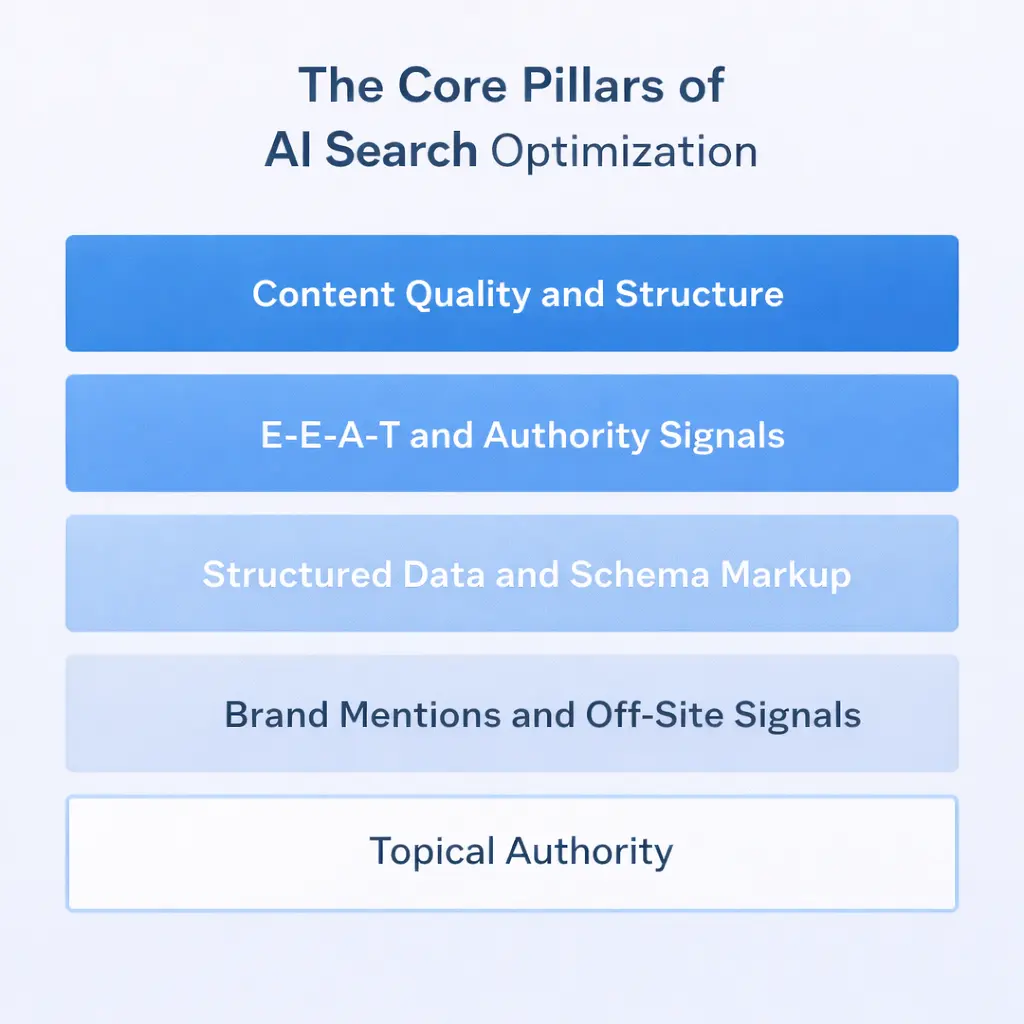
These are the core AI search ranking factors that determine whether your business gets cited, recommended, or ignored by AI search tools. None of them work in isolation. Together they build the kind of authority and trust that AI search platforms consistently reward.
Content Quality and Structure
AI search engines prioritize content that is clear, well-organized, and written by someone who genuinely knows the subject. That means proper heading hierarchy, logical flow, and content that directly answers questions without making the reader dig for the answer.
Structured content wins because AI tools do not read pages the way humans do. They parse content looking for the clearest, most direct answer to the query. The better your heading structure, the more logically your content flows, and the more directly you answer questions, the easier you make it for an AI tool to extract and cite your content confidently. Write in short paragraphs. Use bullet points and numbered lists for steps and comparisons. Remove anything that makes the reader work harder than they need to.
What Content Works Best for AI Search
Not all content formats perform equally. Based on how AI tools retrieve and synthesize information, these formats tend to get cited most consistently:
- How-to guides and step-by-step content that walk through a specific process clearly enough that the AI can summarize the steps and still credit your page as the source
- FAQ content that mirrors the exact conversational phrasing people use when asking AI tools questions, making it easy for the system to match your answer to the query
- Definition and explainer pieces that establish what something is, how it works, and why it matters in plain language without requiring prior knowledge
- Comparison content that evaluates two or more options against specific criteria, giving AI tools a structured, citable answer to “which is better” type queries
- Expert opinion and original insight that offers a perspective or conclusion not available elsewhere, since AI tools actively seek sources that add something beyond what every other page already says
Thin content, keyword-stuffed pages, and vague generalist articles get skipped. AI tools are looking for the most useful, specific, trustworthy answer to the question being asked. Give them that.
E-E-A-T and Authority Signals
Experience, Expertise, Authoritativeness, and Trustworthiness. Google introduced E-E-A-T as a quality framework and it has become arguably more important for AI search than for traditional SEO. AI tools are not just matching keywords to pages. They are evaluating whether a source is credible enough to recommend to a user by name.
Practically, this means:
- Every piece of content should have a visible author bio with relevant credentials because AI tools use author information as a trust signal when deciding whether a source is authoritative enough to cite, a page with no identified author carries significantly less weight than one with a named expert behind it
- Your about page should clearly establish your experience, qualifications, and track record in enough specific detail that both AI tools and human readers can verify you are a genuine authority on the topics you cover, not just another anonymous website
- Every factual claim in your content should be supported by a cited credible source because AI tools actively evaluate whether a page backs up its assertions with evidence, unsourced claims reduce your citation eligibility
- Reviews, testimonials, and consistent third-party mentions signal trustworthiness in a way that AI tools weight differently from traditional SEO, where a backlink was the primary trust currency, AI search looks at the full picture of how your business is talked about across the web
Structured Data and Schema Markup
Schema markup is code that helps search engines and AI tools understand what your content is about without having to interpret it. For small businesses, the highest priority schema types are:
- LocalBusiness schema to establish your business name, location, service area, and contact details in a machine-readable format that AI tools can pull from directly when handling local queries
- FAQ schema to make your question and answer content explicitly machine-readable, increasing the likelihood that your answers get pulled into AI responses for matching queries
- Article schema with author name, credentials, and publication date to reinforce your E-E-A-T signals at a technical level and help AI tools correctly attribute content to a verified human expert
You do not need to be a developer to implement basic schema. Most modern CMS platforms and SEO plugins handle this without touching a line of code.
Brand Mentions and Off-Site Signals
AI search tools do not evaluate your website in isolation. They look at how your business is referenced across the broader web. Consistent NAP citations in local directories, mentions in local news or industry publications, positive reviews on Google and third-party platforms, and genuine PR coverage all contribute to how AI tools perceive your authority and decide whether to recommend you.
This is where local businesses have a genuine advantage that is worth understanding. A well-known local business with strong community ties, consistent directory listings, and a steady flow of genuine reviews can outperform a much larger competitor with weak local signals. A local HVAC company with 200 Google reviews, accurate listings across 30 directories, and two mentions in local news publications will appear more authoritative to a local AI search query than a national brand with no local citation presence in that market.
If you are not sure where to start, building local citations and off-site mentions is one of the highest return activities a small business can invest in for AI search visibility. The businesses that show up consistently in AI answers are almost always the ones with the strongest off-site presence behind them.
Topical Authority
If you have ever felt overwhelmed trying to figure out what content to create, topical authority gives you the answer. Stop chasing individual keywords and start building comprehensive coverage of the topics most relevant to your business.
When your website has multiple pieces of content that collectively cover a subject from multiple angles, AI tools recognize you as an authoritative source on that topic and are significantly more likely to cite you consistently across related queries. One strong page helps. Ten interlinked pages on the same topic cluster signals that your site is the most reliable source available on that subject.
This is exactly why building a content cluster around this pillar post matters. Each cluster post you publish on AI search-related topics, from how AI search engines rank content to how local businesses can appear in AI results, strengthens the topical authority signal that tells AI tools your site belongs at the top of the citation list.
AI Search Optimization for Small and Local Businesses
Small businesses are not behind in AI search. In many cases they are better positioned than the large brands they compete against, and understanding why is one of the most useful things you can take from this guide.
AI search optimization for small businesses is not a scaled-down version of an enterprise strategy. It is a fundamentally different advantage. Large brands have broad reach but they rarely have depth. A local accountant who writes specifically about tax considerations for small businesses in their state, references local regulations by name, and speaks directly to the challenges of their local market is producing content that a national accounting firm simply cannot replicate for that audience. AI tools recognize that specificity and reward it.
Niche authority works the same way. A business that goes deep on a specific service area or specialty will consistently outperform a generalist competitor in AI search results for queries in that niche. Depth beats breadth every time when AI tools are deciding which source to cite.
Here is how local businesses can rank in AI search and build that advantage practically:
- Treat your Google Business Profile optimization as a serious AI search asset, not just a map listing. AI tools handling local queries draw from GBP data directly when generating location-specific recommendations. Understanding the key Google Business Profile ranking factors that influence how AI tools evaluate and recommend local businesses is one of the highest leverage things you can do at this stage. A complete, accurate, and actively maintained profile with updated services, photos, posts, and a consistent business description gives AI tools the structured local data they need to recommend you confidently for relevant queries in your area.
- NAP consistency is a trust signal AI tools actively evaluate. When your business name, address, and phone number appear identically across Google, Yelp, local directories, and industry platforms, AI tools interpret that consistency as a sign of a legitimate, established business. Inconsistencies, even minor ones like “St” versus “Street,” create conflicting signals that reduce your citation authority across local AI search results.
- Reviews are one of the strongest off-site authority signals for local AI search. A steady, consistent flow of genuine reviews across Google, Yelp, and industry-specific platforms tells AI tools that real customers are engaging with your business and finding it credible. Volume matters but so does recency and diversity of platform. A business with 150 Google reviews and 40 Yelp reviews will consistently outperform a competitor with 200 reviews on one platform and nothing elsewhere.
- Create content that answers the exact questions your local customers are already asking AI tools. Check your Google Business Profile questions, your email inquiries, your front desk conversations, and your Google Search Console queries for the real language your customers use. Then write content that answers those specific questions directly, using the same phrasing your customers use, not generic industry language that could apply to any market anywhere.
For Google AI Overviews optimization specifically, your local SEO performance is your starting point. Pages that already rank well in Google organic search are the ones most likely to appear in AI Overviews for local queries. That means every investment you have made in local SEO is already working in your favor here.
Budget is a real constraint and this guide is not going to pretend otherwise. You do not need enterprise tools or a large team. You need consistency, genuine expertise, and a content plan you can actually execute week after week. That is an advantage a small business owner with real local knowledge has over an agency managing fifty national clients at once.
Where to Start With AI Search Optimization (Priority Order)
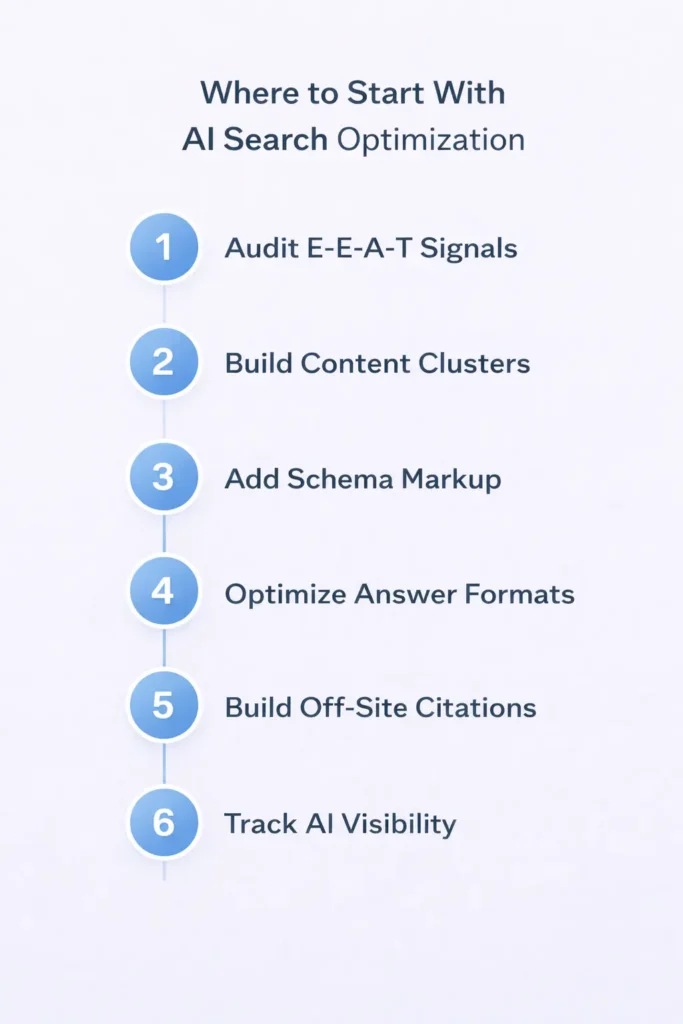
The biggest mistake businesses make is trying to do everything at once. Start here instead:
1. Audit your existing content for E-E-A-T signals. Do your key pages have author bios with real credentials? Are factual claims supported by cited sources? Does your about page establish genuine authority or does it read like a generic company description? Fix these gaps first before creating anything new. A weak foundation will undermine every piece of new content you build on top of it. If you want a professional eye on this, a local SEO audit will surface exactly where your site is losing authority signals before you invest time in new content.
2. Identify your core topics and build content depth. Pick the two or three topics most central to your business and map out a content cluster for each one. A content cluster is a group of interlinked posts that cover a topic from multiple angles, a pillar post that covers the broad topic and several supporting posts that go deep on specific subtopics. Depth on a focused topic beats shallow coverage of many topics every time in AI search.
3. Add structured data to your key pages. LocalBusiness, FAQ, and Article schema are the starting point for most small businesses. Use an SEO plugin or ask your developer to implement these on your highest-priority pages. If you want this handled properly from the ground up, technical SEO and structured data implementation is exactly where professional support pays off. This makes your content explicitly machine-readable and increases the likelihood of AI tools extracting and citing it correctly.
4. Optimize your content for direct answer formats. Go through your existing content and identify pages that could be restructured to answer a specific question more directly. Add FAQ sections to service pages and blog posts. Improve heading structure so each H2 and H3 poses or answers a clear question. Lead with the answer and follow with the supporting detail, not the other way around.
5. Build off-site mentions and citations consistently. Audit your directory listings for NAP accuracy across Google, Yelp, and any industry-specific platforms relevant to your business. Identify two or three local or industry publications where a mention or contribution would be realistic and pursue them actively. Start a review generation process if you do not have one already. A steady flow of genuine reviews across multiple platforms is one of the strongest trust signals available to a small business, and if you want to turn that visibility into action, here is exactly how to get more calls from your Google Business Profile.
6. Set up basic AI search visibility tracking. Open ChatGPT, Perplexity, and Google AI Overviews and run the queries your ideal customers are most likely to ask. Note whether your business or content appears in the responses. Do this once a month and log the results in a simple spreadsheet. Set up a free Mention alert for your business name so you are notified when it appears across the web. This gives you a directional baseline to measure progress against as your optimization efforts build over time.
How to Know If AI Search Optimization Is Working
Measuring AI search visibility is one of the most common frustrations businesses run into when they start taking this seriously. The honest answer is that tracking is still genuinely imperfect. Anyone telling you there is a clean dashboard for this is overstating what currently exists. That said, here is what you can do right now to build a directional picture of how to track brand mentions in AI search and whether your optimization efforts are gaining traction.
Manual spot checks The most accessible and immediately actionable method. Open ChatGPT, Perplexity, and Google AI Overviews and run the queries your ideal customers are most likely to ask. When you do, record the following in a simple spreadsheet:
- Whether your business name or website appears in the response
- Whether your content is cited as a source with a direct link
- Which competitors are being cited in your place
- How the AI describes or characterizes your business when it does mention you
- Whether the response changes over time as you build more authority signals
Do this once a month for your ten most important target queries. The pattern of change over time is more useful than any single snapshot.
- Brand monitoring tools Tools like Mention and Brandwatch track when your business name appears across the web in real time, including in AI-generated content that gets published or indexed. They will not tell you every time ChatGPT mentions your business in a live conversation, since those responses are not publicly indexed. What they do capture is brand mentions across news sites, blogs, directories, and published AI-assisted content, which is a useful proxy for how broadly your name is circulating across the sources AI tools draw from.
- Referral traffic in Google Analytics As your AI search visibility grows you may begin seeing referral traffic from Perplexity directly in Google Analytics, since Perplexity passes referral data through to your site when a user clicks a cited source. Set up a segment or filter for Perplexity referral traffic and monitor it monthly. ChatGPT traffic is harder to attribute directly since it does not consistently pass referral data, but unexplained increases in direct traffic can sometimes indicate growing AI search driven awareness.
Set realistic expectations. AI search optimization is a medium to long-term investment. The businesses seeing meaningful results right now are the ones who started building authority and citation signals six to twelve months ago. Start now and you will be that business for the next wave of competitors entering this space.
Where Search Is Heading and What to Do Next
AI search optimization is not a trend that is going to reverse. It is a structural shift in how people find information, make decisions, and discover businesses. The fundamentals that have always mattered in SEO matter more now, not less. Quality content, genuine authority, and a trustworthy online presence are the foundation of both traditional search visibility and AI search, and the businesses that treat them as a long-term investment are the ones pulling ahead.
You do not need to overhaul everything at once. Pick one step from the priority framework above and start there this week. Audit your E-E-A-T signals. Fix your schema markup. Improve one piece of content to answer a question more directly. Small consistent actions compound into real topical authority over time, and that authority is exactly what AI search tools are looking for when they decide who to cite.
The businesses winning in AI search are not the ones with the biggest budgets. They are the ones who started building authority before everyone else caught on. If you are a small service business looking for hands-on support with local lead generation and AI search visibility, that is exactly what we help with.